
INTERACTIVE IMAGE
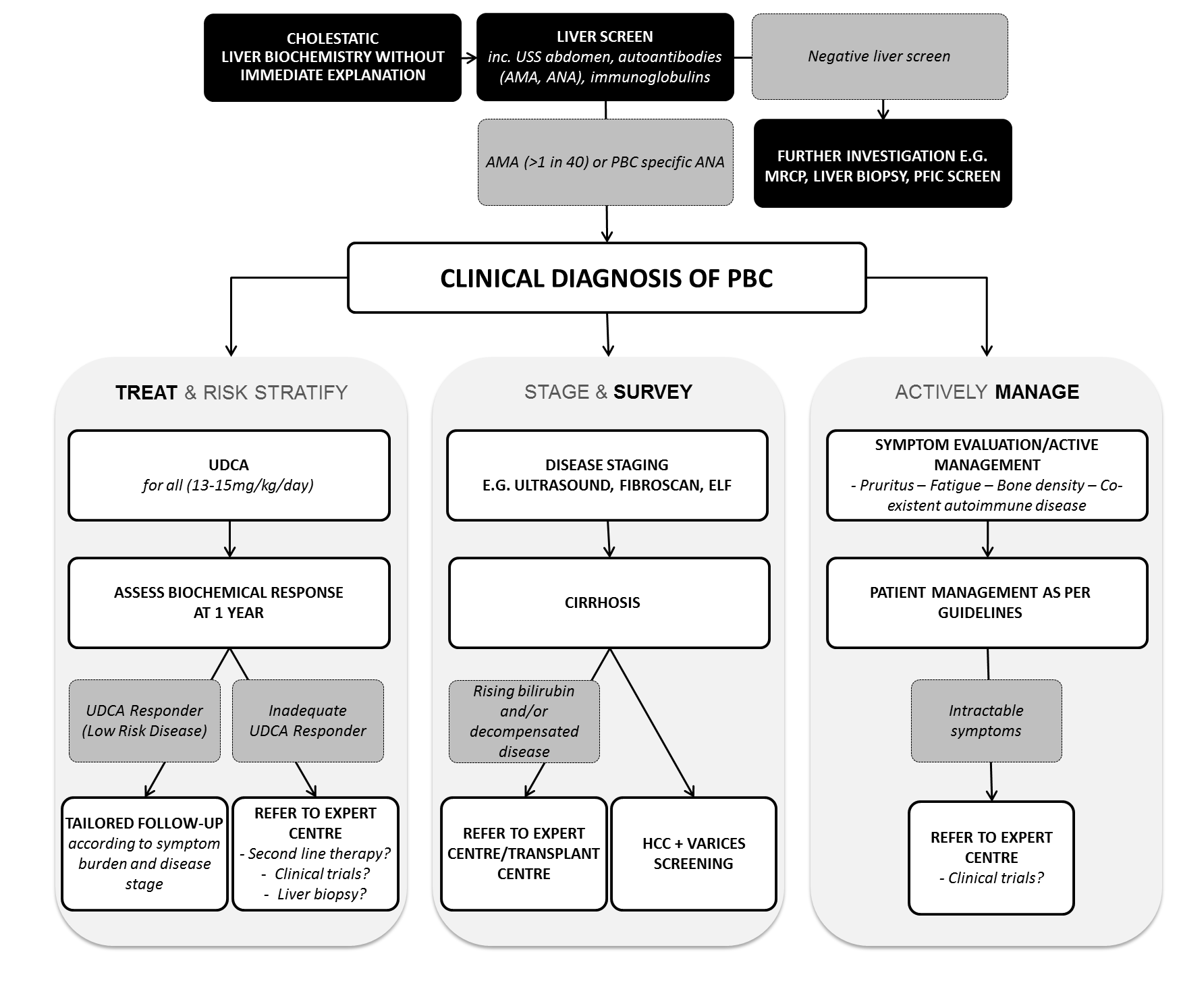
Click a flowchart box to read the recommendations made in the BSG/UK-PBC guidelines. Each recommendation will take you to the section within the guidelines to which it is referenced.
If you wish to download the full guidelines as a PDF, please use the link below.
 Download Full Guideline PDF 67Kb
RECOMMENDATION 1:
Any patient with persistently elevated cholestatic liver biochemistry (raised ALP or GGT) without an alternative cause, should have their auto-antibodies checked (ANA and AMA). (EL 2++, strong)
RECOMMENDATION 1:
Any patient with persistently elevated cholestatic liver biochemistry (raised ALP or GGT) without an alternative cause, should have their auto-antibodies checked (ANA and AMA). (EL 2++, strong)
RECOMMENDATION 2:
The presence of AMA (greater than 1 in 40) or PBC-specific ANA in the context of cholestatic liver biochemistry is sufficient for reaching the diagnosis of PBC in the absence of alternate liver disease. (EL 2++, strong)
RECOMMENDATION 7:
In the absence of diagnostic autoantibodies, the confirmation of PBC requires a liver biopsy. (EL 2++, strong)
RECOMMENDATION 8:
Liver biopsy can be considered if there is a clinical suspicion of co-existing disease (e.g. additional injury from NAFLD, viral hepatitis or alcohol use) or the presence of overlapping autoimmune hepatitis, either at diagnosis or during follow up. (EL 4, strong)
HOW IS PBC DIAGNOSED?
RECOMMENDATION 12:
Ursodeoxycholic acid at 13-15mg/kg/day is recommended as the first-line pharmaco-therapy in all patients with PBC. If tolerated treatment should be lifelong. (EL 1-, strong)
RECOMMENDATION 13:
Individualised risk stratification using biochemical response indices is recommended following one year of UDCA therapy. (EL 2++, Strong)
RECOMMENDATION 3:
For patients in whom the clinical suspicion for PBC is high, but classical indicators of disease are discordant (e.g. normal liver biochemistry, serology at a low titre) further investigation and review is required prior to establishing a diagnosis of PBC or initiating therapy. (EL 4, strong)
RECOMMENDATION 14:
Inadequate response to UDCA is robustly associated with a greater likelihood of future liver transplantation, development of hepatocellular carcinoma and death. For those patients, clinicians should consider discussion with a liver disease specialist and the opportunity for clinical trial participation, in the absence of access to licenced second line therapies. It is of note that current clinical trials focused on disease modification have used an inclusion criteria that stratifies based on ALP and Bilirubin (e.g. an ALP value of at least 1.67 times the upper limit of the normal range or an abnormal total bilirubin) (EL 4, strong)
RECOMMENDATION 4:
All patients with suspected PBC should have a baseline abdominal ultrasound as part of their assessment. (EL 2++, strong)
RECOMMENDATION 6:
There are a range of non-invasive tools to stage and monitor disease progression. There is no consensus as to what is the optimal strategy, but clinicians should be aware of an evolving likely clinical utility. (EL 2-, strong)
RECOMMENDATION 20:
In all patients with a bilirubin >50µmol/L or evidence of decompensated liver disease, consideration should be made regarding suitability for liver transplantation, through discussion with a hepatologist linked to a liver transplant programme. (EL 4, strong)
RECOMMENDATION 23:
Decompensated liver disease should be treated as in standard practice. (EL 4, strong)
RECOMMENDATION 20:
In all patients with a bilirubin >50µmol/L or evidence of decompensated liver disease, consideration should be made regarding suitability for liver transplantation, through discussion with a hepatologist linked to a liver transplant programme. (EL 4, strong)
RECOMMENDATION 23:
Decompensated liver disease should be treated as in standard practice. (EL 4, strong)
HEPATOCELLULAR CARCINOMA (HCC):
Patients with PBC who have cirrhosis are at increased risk of hepatocellular carcinoma (HCC) as in other forms of chronic liver disease[200, 201]. The majority of HCC in patients with PBC occurs in those with cirrhosis although there are reports of HCC in patients who are non-cirrhotic [202].There are some important factors which identify patients as being at increased risk (in addition to cirrhosis). Non-responders to treatment are at greater risk and men are more likely to get HCC than women in PBC (of note given that PBC is much less common in males)[202, 203]. Screening should be undertaken in accordance with international guidelines[197, 198, 199]. There is an absence of specific UK guidelines currently. Currently, guidelines advise abdominal ultrasound (USS) at 6 monthly intervals. Alpha-fetoprotein (AFP) has recently been removed from some international guidelines but is still widely used in clinical practice alongside USS. The discussion of the health economics of HCC screening in PBC is outside the remit of these guidelines, but note should be taken of increasing loco-regional therapies for HCC applicable to patients of all ages.
 Click to skip to the 'Hepatocellular Carcinoma (HCC)' section
RECOMMENDATION 21:
HCC can complicate PBC. In patients where cirrhosis is suspected, HCC surveillance should be carried out according to international guidelines. (EL 3, strong)
RECOMMENDATION 14:
Inadequate response to UDCA is robustly associated with a greater likelihood of future liver transplantation, development of hepatocellular carcinoma and death. For those patients, clinicians should consider discussion with a liver disease specialist and the opportunity for clinical trial participation, in the absence of access to licenced second line therapies. It is of note that current clinical trials focused on disease modification have used an inclusion criteria that stratifies based on ALP and Bilirubin (e.g. an ALP value of at least 1.67 times the upper limit of the normal range or an abnormal total bilirubin) (EL 4, strong)
SYMPTOM MANAGEMENT:
The symptoms associated with PBC are important and have a significant impact on life quality for patients[149]. Data from the UK-PBC patient cohort have shown that there is significant variation in management between centres and individual clinicians[10]. It is hoped that these guidelines will help standardise the approach to symptom management by clinicians. It is our expert opinion that screening for the presence of symptoms by asking about them specifically, followed by offering formal quantification of their impact in patients reporting their presence, can be helpful in understanding the impact on individual patients (approaches can include Likert or visual analogue scales, which are well established for itch particularly and the use of more complex patient-derived measures such as the multi-domain PBC-40 quality of life measure[150, 151]). Therapies for symptoms should be continuously evaluated rather than on an ad hoc basis and it is important to re-evaluate symptoms and response to therapy. There is also a risk of recurring symptoms on stopping therapy and most patients require treatment long-term. The symptoms of PBC typically do not correlate with disease severity and do not improve with UDCA therapy[10].
Click to skip to the 'Symptom Management' section
RECOMMENDATION 15:
All patients should be evaluated for the presence of symptoms, particularly fatigue and itch. Clinicians should recognise that severity of symptoms does not correlate with stage of disease. (EL 4, strong)
RECOMMENDATION 16:
Cholestyramine is first-line therapy for pruritus and should be taken separately to UDCA to avoid interaction. (EL 2+, strong)
RECOMMENDATION 17:
Rifampicin is the recommended second-line therapy for pruritus. (EL 1-, strong)
RECOMMENDATION 18:
Alternate causes of fatigue should be sought and treated. (EL 2-, strong)